
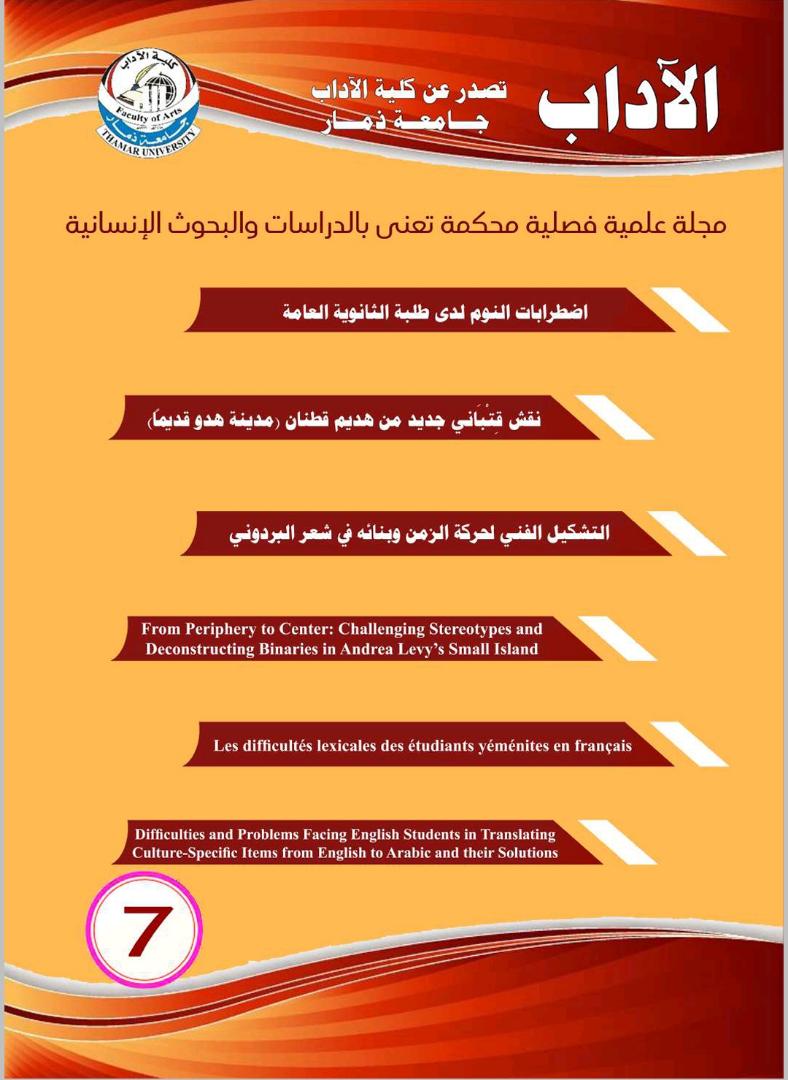
The Artistic Formation and Construction of the Time Movement in Al-Bardouni's poetry
DOI:
https://doi.org/10.35696/.v1i7.515Keywords:
Artistic formation, Movement of time, Berdawni poetry, Vision PhilosophyAbstract
This research investigates the presence of time in Al-Bardouni's poetry as a prominent stylistic and constructive phenomenon which has received wide attention and a remarkable diversity. Looking at the structures of these thresholds revealed their regularity within three time stations, which carried within them an excessive sense of the movement of reality and the depth of its reflection in the self. Al-Bardouni's celebration of the movement of time was also embodied by his presence in the thresholds of his poems and in the folds of poetic texts. The importance of time crystallized in his poetry from the fact that his perspective of time is shaped in a prominent way according to a consciousness that monitors reality, then re-represents the images of its reflection in the self, and this is manifested in various images and many formations, open to the past, present and future.Downloads
Download data is not yet available.
Downloads
Published
2018-06-01
Issue
Section
1
License
Copyright (c) 2021 ياسر فضل صالح العامري (مؤلف)

This work is licensed under a Creative Commons Attribution 4.0 International License.
Copyright and Licensing
For all articles published in journal, copyright is retained by the authors. Articles are licensed under an open access Creative Commons CC BY 4.0 license, meaning that anyone may download and read the paper for free. In addition, the article may be reused and quoted provided that the original published version is cited. These conditions allow for maximum use and exposure of the work.
How to Cite
Al Ameri, Y. F. S. . (2018). The Artistic Formation and Construction of the Time Movement in Al-Bardouni’s poetry. Arts, 1(7), 354-379. https://doi.org/10.35696/.v1i7.515