
Some Features of the Commercial Activity and Political Systems of the Arabs of Southern Arabia at the Beginning of the Codification Era
DOI:
https://doi.org/10.35696/.v1i00.418Keywords:
civilization, South of the peninsula, trade, Incense and spicesAbstract
This research is aiming to highlights some features of the commercial activity and political systems of the Arabs of the south of the Arabian Peninsula at the beginning of the codification era. It shows that the emergence of an Arab civilization in the southwestern corner of the continent of Asia lasted thousands of years and was woven at the junction of the second and first millennium BC until the middle of the first millennium AD. Commercially, the civilization of southern Arabia was distinguished from other civilizations of the ancient world by two main features: it is dominated for more than a thousand years the trade of incense and spices, and the second is that the Arab countries followed in their system of rule the method of the electoral cycle of rulers, which is much like the regimes of some countries of the civilized world today.Downloads
Download data is not yet available.
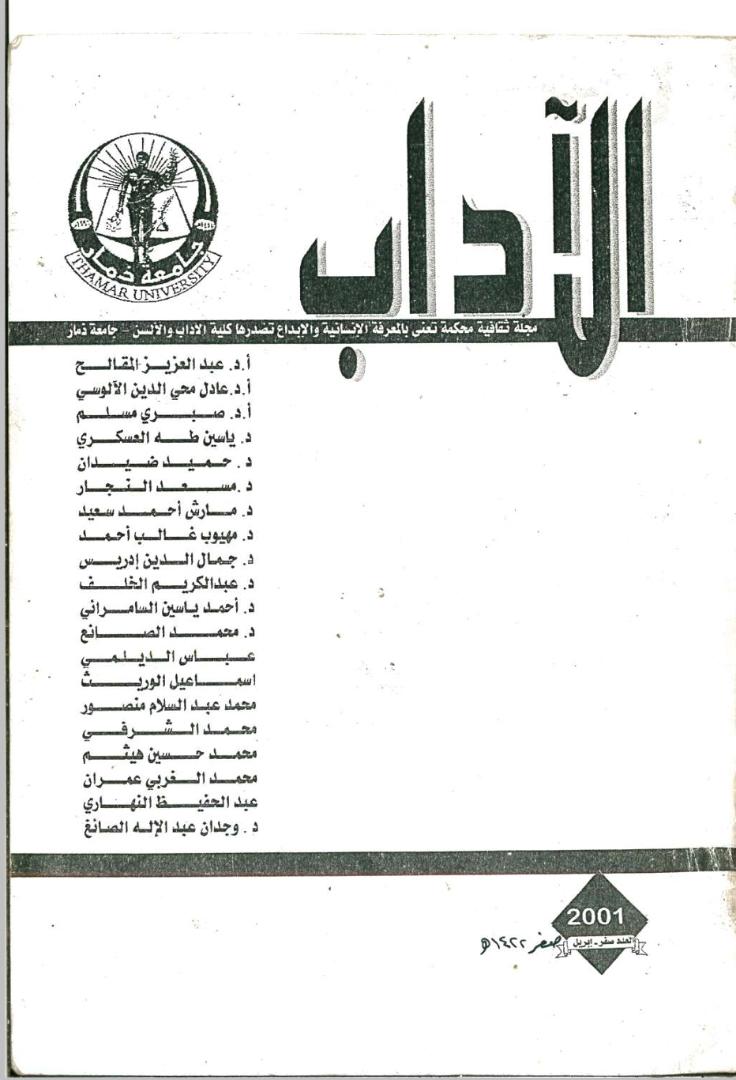
Downloads
Published
2001-04-01
Issue
Section
1
License

This work is licensed under a Creative Commons Attribution 4.0 International License.
Copyright and Licensing
For all articles published in journal, copyright is retained by the authors. Articles are licensed under an open access Creative Commons CC BY 4.0 license, meaning that anyone may download and read the paper for free. In addition, the article may be reused and quoted provided that the original published version is cited. These conditions allow for maximum use and exposure of the work.
How to Cite
Ahmed, M. G. . (2001). Some Features of the Commercial Activity and Political Systems of the Arabs of Southern Arabia at the Beginning of the Codification Era. Journal of Arts, 1(00), 98-109. https://doi.org/10.35696/.v1i00.418

Similar Articles
- Mogalli Hamood Al-Raeeini, Political Conditions in the Northern Arabian Peninsula and its Influence on the Trade of the ancient Yemen from the (4th Century BC – 2nd Century AD) , Journal of Arts: Vol. 13 No. 3 (2025)
- Salma Bint Mohammed Bakr Hosawi, Historical Cultural Significance of Tayma City in the Sixth Century B.C. , Journal of Arts: Vol. 11 No. 1 (2023)
- Amal AbdulMoez Saleh Al- Hemyari, The French Missions to the Yemeni Ports (1736 – 1709 AD) , Journal of Arts: No. 24 (2022)
- Saeed Ali Abdullah Al-Shahrani, Arab Coffee Trade from the 16th to the 19th Century AD , Journal of Arts: Vol. 12 No. 1 (2024)
- Noof Hamdi Hamdan Al-Harbi, The Historical Arab-Islamic Role of Chinese Civilization and Its Impact on Economic Life (1054-1329 AH/1614-1911 AD) , Journal of Arts: Vol. 13 No. 4 (2025)
- Mahyoub Ghaleb Ahmed, Historical Connections between Southern Arabia, the Fertile Crescent and Egypt during the First Millennium BC , Journal of Arts: No. 3 (2007)
- Mustafa Suleiman Labban, The Impact of Historical Geography on the Cultural Formation in Hejaz before Islam , Journal of Arts: No. 18 (2021)
- Mogalli Hamood Al-Raeeini, The Yemen-India Commercial Relations During the Period (3rd Century BC- 1ST Century AD) , Journal of Arts: Vol. 13 No. 2 (2025)
- Mahyoub Ghaleb Ahmed Kulaib, The Development of Shipping Lines in Southwest Asia between the 3rd and 1st Millennium BC , Journal of Arts: No. 5 (2009)
- Rahma Bint Awaad Ahmad Al-Sinani, Religious Life in Al-Faw Village An Archeology-based Study , Journal of Arts: No. 18 (2021)
1-10 of 50
Next
You may also start an advanced similarity search for this article.
Most read articles by the same author(s)
- Mahyoub Ghaleb Ahmed, A Brief Review of the Book of the Russian Sebaeologist Avram Lundin: The State of the Megabarians of Sheba (The Sabian Eponym), Moscow Dar Al-Ilm, 1971 , Journal of Arts: No. 1 (2002)
- Mahyoub Ghaleb Ahmed, Historical Connections between Southern Arabia, the Fertile Crescent and Egypt during the First Millennium BC , Journal of Arts: No. 3 (2007)