
The Theory of the Hero in History: A Study in the Philosophy of History and its Interpretations
DOI:
https://doi.org/10.35696/.v1i00.416Keywords:
hero theory, History, ExplanationsAbstract
This research focuses on the theory of the hero in history to reveal who made the events of history and influence its course: Individuals or groups, Rulers or peoples. The theory of the hero is one of many about history which focuses on the explanations of history and the role of the individual in it. It also explains the concept of the heroes for the philosophers of social determinism, in the image of the Messenger (PBUH), and At Sydney Hook.Downloads
Download data is not yet available.
Downloads
Published
2001-04-01
Issue
Section
1
License

This work is licensed under a Creative Commons Attribution 4.0 International License.
Copyright and Licensing
For all articles published in journal, copyright is retained by the authors. Articles are licensed under an open access Creative Commons CC BY 4.0 license, meaning that anyone may download and read the paper for free. In addition, the article may be reused and quoted provided that the original published version is cited. These conditions allow for maximum use and exposure of the work.
How to Cite
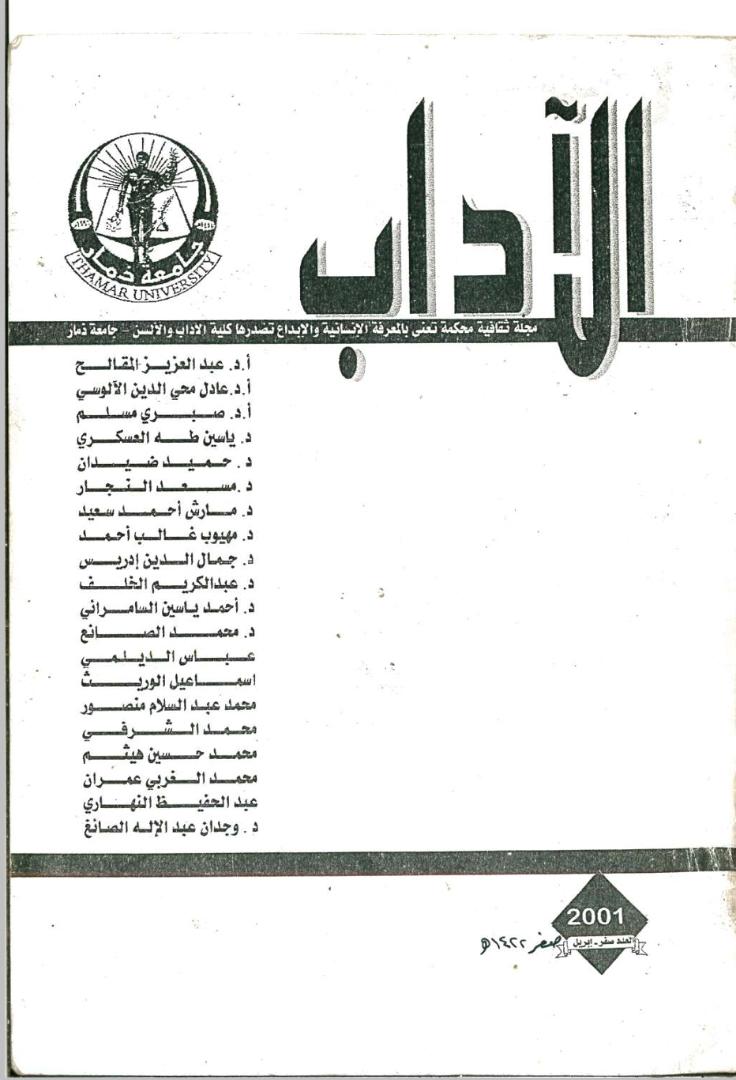
Al-Askari, Y. T. . (2001). The Theory of the Hero in History: A Study in the Philosophy of History and its Interpretations. Journal of Arts, 1(00), 61-76. https://doi.org/10.35696/.v1i00.416

Similar Articles
- Saad Ibrahim Al-Alawi, The Historical Material Interpretation and the Arab Islamic Intellectual Heritage - Socio-Epistemological Approach , Journal of Arts: No. 3 (2007)
- Wael Bin Sultan Al-Harethi Al-Shareef, Historical research in Islamic Jurisprudence Principles Vision, Domains and Horizons , Journal of Arts: Vol. 11 No. 2 (2023)
- Aref Ahmad Ismail Al-Mekhlafi, Renewable updated History: A New Term for Framing Muslim Intellectual OutputYield , Journal of Arts: Vol. 11 No. 2 (2023)
- Ahmed Ahmed Al-Arami, Abdul-Wadud Qasim Hassan Mukasher, The Metaphysical Dimension of History for Hegel: The Path of Freedom as a Root , Journal of Arts: No. 8 (2018)
- Abdulaziz Hasan Ahmed Alwadhaf, The Social Contract and State Construction: A Comparative and Analytical Study of the Different Trends of this Theory , Journal of Arts: No. 13 (2019)
- Abdulhakim Abdulhk Mohammed Saifaddin, The Transformation of Northern Arbitah in the Abbasid Era from Military Bases into Learning Centers Prof. Abdulhakim Abdulhk Mohammed Saifaddin , Journal of Arts: No. 14 (2020)
- Raad Zahraw Al-Mousawi, A Critical study of Bamkharrama’s Resources in The History of the Gap of Aden , Journal of Arts: No. 4 (2008)
- Salman Bin Abdulaziz Al-Humaidah, Effectiveness of an Enrichment Program Based on Bruner’s Narrative Theory in Developing Creative Thinking Skills among Gifted Third-Grade Intermediate Students , Journal of Arts: Vol. 13 No. 2 (2025)
- Ibrahim Ateetallah Al-Sulami, Anisha Andalusian Fortress During the period from the fourth century A H to the first half of the seventh century A H; Tenth to the first half of the thirteenth century AD: A Historical and Civilized Study , Journal of Arts: No. 13 (2019)
- Abdullah Abdul-Karim Al-Ahdal, The Image of Muslims and Colonists in the History Books of General Secondary Education and Scientific Institutes in the Republic of Yemen , Journal of Arts: No. 1 (2002)
1-10 of 66
Next
You may also start an advanced similarity search for this article.