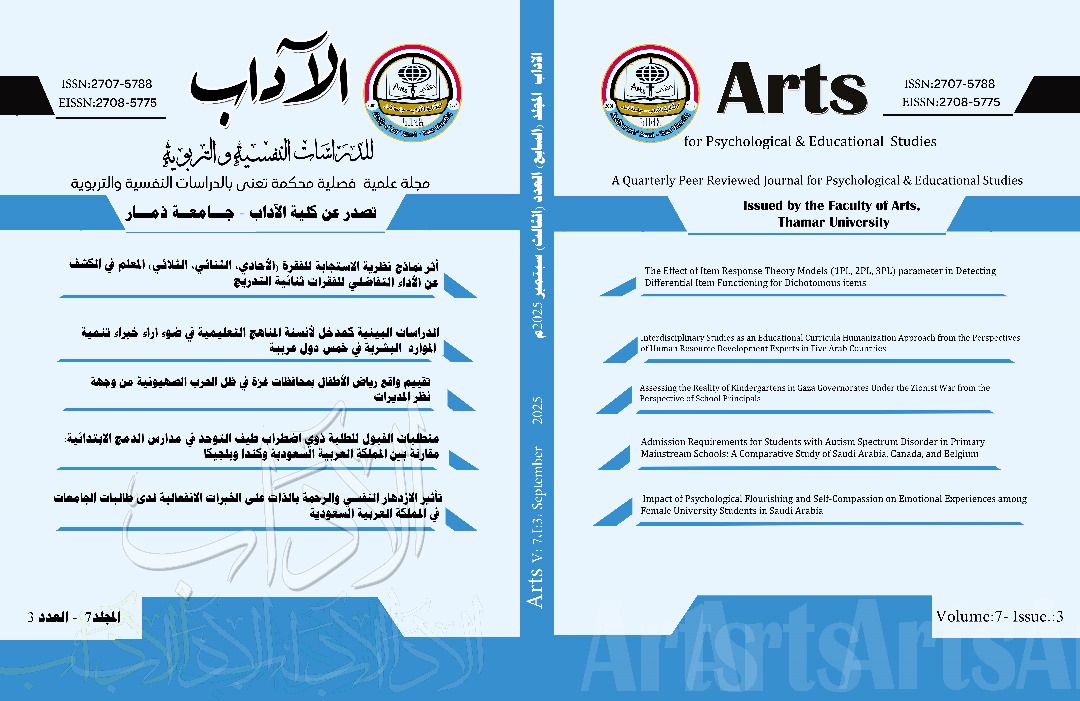
The Effect of Item Response Theory Models (1PL, 2PL, 3PL) parameter in Detecting Differential Item Functioning for Dichotomous items
DOI:
https://doi.org/10.53285/artsep.v7i3.2791Keywords:
Item Response Theory, Differential Item FunctioningAbstract
This study aimed to investigate the impact of different Item Response Theory (IRT) models on the detection of Differential Item Functioning (DIF) in dichotomously scored items. To achieve this objective, an achievement test in mathematics was developed to assess the mathematical proficiency of third-grade intermediate school students. The final version of the test consisted of (20) items. After verifying the assumptions of IRT and establishing acceptable validity and reliability indices, the test was administered to a sample of (1000) male and female students from schools under the aUraija Education Office in Riyadh City. Data were analyzed using several statistical software packages, including Bilog-MG3, R studio, and SPSS v25. The results revealed that the three-parameter model identified the highest proportion of items with DIF at (70%), followed by the two-parameter model at (65%), and then the one-parameter model at (50%). Furthermore, the one-parameter model was found to be the most effective in mitigating the impact on DIF for dichotomous items, as it yielded the smallest number and proportion of items exhibiting DIF compared to the other parameterized models (two-parameter and three-parameter).
References
الصراف، قاسم علي. (2014). القياس والتقويم في التربية والتعليم. القاهرة: دار الكتاب الحديث.
العناتي، جهاد. (2017). الأداء التفاضلي لفقرات اختبار الذكاء غير اللفظي TONI-4 وفقاً لجنس الطالب ودخل الأسرة والمستوى التعليمي للأم، مجلة دراسات تربوية، 60، 60-72.
الفقي، إسماعيل. (2014). التقويم والقياس النفسي والتربوي (ط3). مكتبة الرشد للنشر.
دي ايالا، ر. ج. (2017). النظرية والتطبيق في نظرية الاستجابة للفقرة (ترجمة عبد الله الكيلاني وإسماعيل البرصان). دار جامعة الملك سعود للنشر. (2009).
زكري، علي. (2009). الخصائص السيكومترية لاختبار (أوتيس-لينون) للقدرة العقلية مقدرة وفق القياس الكلاسيكي ونموذج راش لدى طلبة المرحلة المتوسطة بمحافظة صبيا التعليمية. [رسالة دكتوراه]، جامعة أم القرى.
ضعضع، هبة. (2023). أثر اختلاف نموذج الاستجابة للمفردة (1PL, 2PL, 3PL) في الأداء التفاضلي للمفردة. مجلة الأستاذ للعلوم الإنسانية والتربوية، 62(1)، 23-44.
عبد الوهاب، محمد. (2010). استخدام نماذج الاستجابة للمفردة الاختبارية في تدريج مفردات بعض الاختبارات المعرفية. [رسالة دكتوراه غير منشورة]. جامعة المنيا.
علام، صلاح الدين. (2000). القياس والتقويم التربوي والنفسي، أساسياته وتطبيقاته وتوجهاته المعاصرة. دار الفكر العربي.
عودة، أحمد. (2010). القياس والتقويم في العملية التدريسية. دار الأمل للنشر والتوزيع.
فريحات، أيمن. (2014). أثر عدد البدائل في تقدير معالم فقرات الاختبار وفقاً لنماذج الاستجابة للفقرة [أطروحة دكتوراه]. جامعة اليرموك
محمود، سومية. (2012). استخدام نموذج راش في بناء بنك أسئلة لقياس التحصيل في مقرر سيكولوجية التعلم لدى طلاب كلية التربية بالمنيا [رسالة دكتوراه غير منشورة]. جامعة المنيا.
Arabic References
Al-‘Anati, J. (2017). Al-ada’ al-tafaduli li-fiqrat ikhtibar al-dhaka’ ghayr al-lafzi TONI-4 wafqan li-jins al-talib wa-dakhl al-usra wa-al-mustawa al-ta‘limi li-al-umm. Majallat Dirasat Tarbawiyya, 60(60), 60–72.
Al-Faqi, I. (2014). Al-taqwim wa-al-qiyas al-nafsi wa-al-tarbawi (3rd ed.). Riyadh: Maktabat al-Rushd li-al-Nashr.
Al-Sarraf, Q. A. (2014). Al-qiyas wa-al-taqwim fi al-tarbiyya wa-al-ta‘lim. Cairo: Dar al-Kitab al-Hadith.
‘Allam, S. al-Din. (2000). Al-qiyas wa-al-taqwim al-tarbawi al-nafsi: Asasiyyatuhu wa-tatbiqatuhu wa-tawajuhatuhu al-mu‘asira. Cairo: Dar al-Fikr al-‘Arabi.
‘Awda, A. (2010). Al-qiyas wa-al-taqwim fi al-‘amaliyya al-tadrisiyya. Irbid: Dar al-Amal li-al-Nashr wa-al-Tawzi‘.
De Ayala, R. J. (2017). Al-nazariyya wa-al-tatbiq fi nazariyyat al-istijaba li-al-fiqra (Trans. ‘Abd Allah al-Kilani & Isma‘il al-Barsan). Riyadh: Dar Jami‘at al-Malik Saud li-al-Nashr. (Original work published 2009).
Dha‘dha‘, H. (2023). Athar ikhtilaf namudhaj al-istijaba li-al-mufrada (1PL, 2PL, 3PL) fi al-ada’ al-tafaduli li-al-mufrada. Majallat al-Ustadh li-al-‘Ulum al-Insaniyya wa-al-Tarbawiyya, 62(1), 23–44.
Frihat, A. (2014). Athar ‘adad al-badail fi taqdir ma‘alim fiqrat al-ikhtibar wafqan li-namadhij al-istijaba li-al-fiqra [Unpublished doctoral dissertation]. Yarmouk University.
Mahmoud, S. (2012). Istikhdam namudhaj Rash fi bina’ bank as’ila li-qiyas al-tahsil fi muqarrar sikulujiyyat al-ta‘allum lada tullab kulliyat al-tarbiyya bi-al-Minya [Unpublished doctoral dissertation]. Minia University.
‘Abd al-Wahhab, M. (2010). Istikhdam namadhij al-istijaba li-al-mufrada al-ikhtibariyya fi tadrij mufradat ba‘d al-ikhtibarāt al-ma‘rifiyya [Unpublished doctoral dissertation]. Minia University.
Zakkari, A. (2009). Al-khasais al-sikumitriyya li-ikhtibar (Otis–Lennon) li-al-qudra al-‘aqliyya muqaddara wafqan li-al-qiyas al-kilāsiki wa-namudhaj Rash lada tullab al-marhala al-mutawassita bi-muhafazat Sabya al-ta‘limiyya [Unpublished doctoral dissertation]. Umm al-Qura University.
ثانيا: المراجع الإنجليزية:
Aljoudeh, Majed. (2021). Item response Theory likelihood-ratio test (IRT-LR) performance for detecting differential item functioning (DIF) in different sample sizes and different levels of (DIF) items. Vidyabharati International interdisciplinary Research Journal, 13(1), 392-399.
Bejar, I. I. (1980). A procedure for investigating the Unidimensionality of Achievement test based on item parameter estimates. Journal of Educational Measurement. 17(4), 283
Bryant, D. U. (2004). The Effects of Differential Item Functioning on Predictive Bias. Doctoral Dissertation, Orlando Florida: University of Central Florida.
Camilli, G. & Shepard, L. (1994). Method for Identifying Biased Test Items. CA: Sage Publications.
Cohen, A.S., Kim, S.H., & Wollack, J.A. (1996). An Investigation of the Likelihood Ratio Test for Detection of Differential Item Functioning. Applied Psychological Measurement, 20(1), 15-26.
Crocker, L. & Algina, J. (1986). Introduction to Classical and Modern Test Theory. New York: CBS College Publishing.
De Gruijter, Dato. N. M. & Van Der Kamp, L. J. Th. (2008). Statistical Test Theory for the Behavioral Sciences. NW: Taylor & Francis Inc.
Embretson S. E. & Reise, S. P. (2000). Item Response Theory for Psychologists. Mahwah, Lawrence Erlbaum Associates.
Felder, R.M. & Spurlin, J. (2005) Applications, reliability and validity of the index of learning styles. International Journal of Engineering Education, 21, 103-112.
Gronlund, N. & Linn, R. (1990). Measurement and evaluation in teaching (6th ed.). New York: Macmillan publishing company, PP. 166 - 189.
Hambleton, R. K. & Swaminathan, H. (1985). Item Response Theory: Principles and Applications. Boston: Kluwer, Nijh of publishing.
Hambleton, R. K. & Swaminathan, H. & Rogers, H.J. (1991). Fundamentals Of Item Response Theory. CO: Newbury Park, The International Professional publishers.
Hambleton, R. K. & Rodgers. (1995). Item bias review. Practical Assessment, Research & Evaluation, 4(6). Available online: http://PAREonline.net/getvn.asp?v=4&n=6.
Jensen, A. R. (1980). Précis of bias in mental testing. Behavioral and Brain Sciences, 3(3), 325-371.
Reckase, M.D. (1979). Unifactor Latent Trait Models Applied to Multifactor test: Results and Implications. Journal of educational statistics, 4(3), 207-230.
Rupp, A. (2013). A systematic review of the methodology for person fit research in item response theory: Lessons about generalize-ability of inferences from the design of simulation studies. Psychological Test and Assessment Modeling, 55(1), 3-38./
Downloads
Published
Issue
Section
License

This work is licensed under a Creative Commons Attribution 4.0 International License.
Copyright and Licensing
copyright is retained by the authors. Articles are licensed under an open access Creative Commons CC BY 4.0 license, meaning that anyone may download and read the paper for free. In addition, the article may be reused and quoted provided that the original published version is cited. These conditions allow for maximum use and exposure of the work.
How to Cite